Weapons of Math Destruction
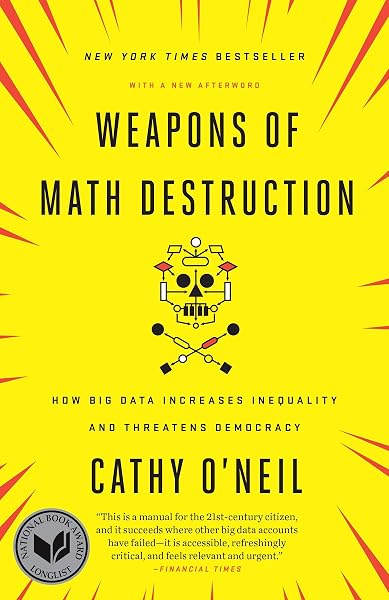
When an algorithm decides who gets a loan, a job, or a longer sentence, and nobody can explain why. A mathematician on how models encode bias and escape accountability.
The three tests
O'Neil was a quantitative analyst on Wall Street, and she is not opposed to models. Her argument is narrower and more useful: some models are harmful, and there is a way to tell which.
Her test has three parts. Is the model opaque, so that the people subject to it cannot see how it works? Does it operate at scale, so that its errors affect thousands of people? And does it do damage — deny a loan, a job, a place at university, or a parole?
All three together make a weapon of math destruction. A model missing any one of them is a much smaller problem.
The teacher who was fired by a formula
The book opens with a case study. A teacher in Washington DC was rated highly by her principal and her students, then fired because a value-added model scored her poorly.
The model had no way to account for the fact that her class had lost several students mid-year, or that she had inherited a difficult group. It produced a number, the number was treated as fact, and there was no process to question it.
Recidivism scores
The COMPAS case is the best-known example. A model estimated the likelihood that a defendant would reoffend, and judges used the score in sentencing.
The problem is not that the model was inaccurate in aggregate. It is that the errors were not distributed evenly: the false positive rate was much higher for Black defendants. A model can be right on average and systematically wrong for a group, and the aggregate statistic hides exactly the harm that matters.
Feedback loops
The most important mechanism in the book. Suppose a model predicts which neighbourhoods are risky for lending and denies loans there. The neighbourhood then cannot improve, becomes riskier, and confirms the model.
The prediction created the outcome it predicted. This is why a model can be technically accurate and still cause the harm it claims to measure.
Proxies
Models rarely have a variable called race. They have postcode, shopping history, credit usage, and a hundred other variables that correlate with it.
Removing the explicit variable does not remove the discrimination, because the correlated variables carry it. This is the technical reason why "we do not use race in the model" is not a defence.
What gets measured gets distorted
When a model rewards a metric, people optimise the metric rather than the goal. Schools teach to the test. Police patrol where the model says crime is, find more crime there, and generate data confirming the model.
O'Neil calls this the gap between what we can measure and what we actually care about, and argues that most damaging models live in that gap.
What she proposes
Not a ban. She argues for auditing, transparency to the people affected, the right to appeal a decision to a human, and ethical review before deployment — the same kind of scrutiny a medical trial receives.
She is realistic about the resistance. The appeal process is expensive, and the opacity is often commercially convenient, which is precisely why the pressure has to come from outside.
The bottom line
Ask three questions of any system that scores people: can the subject see how it works, does it act at scale, and can it be appealed? If the answers are no, yes, no, then the mathematics is not neutral — it is a decision-making machine with no one accountable for its errors.
🔑 Key actionable ideas
- A weapon of math destruction has three properties: it is opaque, it operates at scale, and it does damage.
- Models are not objective. They encode the choices, proxies, and priorities of the people who built them.
- Proxy variables let discrimination back in through the side door — a postcode or a credit history can stand in for race.
- Feedback loops make a biased model self-confirming: a low score causes the outcome the score predicted.
- The absence of appeal is the real harm. A wrong decision by a person can be argued with; a wrong decision by a model usually cannot.
Who is this book for?
Anyone subject to an automated decision, and technologists who want to understand the social consequences of the systems they build.
Final verdict
A clear, well-reported argument that names a real and under-discussed harm. The treatment of feedback loops and proxies is genuinely illuminating, though the policy proposals are the thinnest part.