The Innovator's Dilemma
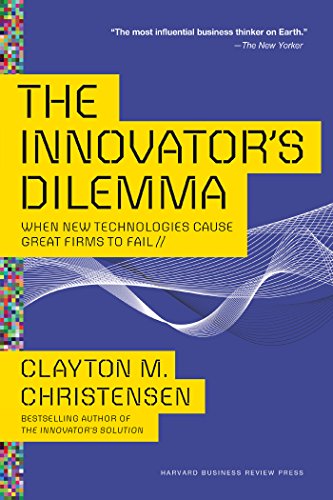
Why do well-managed companies lose to small entrants with worse products? Christensen's answer is that the same decisions that make them successful are the problem.
The Core Idea
The uncomfortable claim at the centre of this book is that a company can fail by doing everything its customers ask for. Christensen studied established firms in several industries and found a repeating pattern: the leaders did not collapse because they were incompetent or careless. They collapsed because they made the rational investment decision, again and again, in favour of the products their most profitable customers wanted.
The title is therefore precise. It is a dilemma, not a mistake. There is no obvious action that is both good for the current business and good for the disruptive one, because the two have different customers, different margins and different cost structures.
Sustaining versus disruptive
A sustaining innovation makes an existing product better along the dimensions that established customers already value. Faster, bigger, more feature-rich. Incumbents are extremely good at this, and they should be: it is how they serve the people who pay them.
A disruptive innovation begins with a product that is worse by those same measures. It is cheaper, simpler, smaller or more convenient, and it appeals to customers who were ignored or were not customers at all. Only later does it improve enough to win the mainstream.
That is why the word has been so badly diluted. A impressive new technology is not automatically disruptive. If it enters at the top of the market and serves the best customers first, it is a sustaining innovation, no matter how novel it is.
Why good managers make the wrong call
Christensen's explanation runs through resource allocation. Companies fund what earns returns, and returns come from existing customers with existing needs. A small new market with low margins cannot justify the investment when a well-understood improvement promises a certain sale to a major account.
Managers who ignore the small market are not short-sighted. Given the information and incentives they have, they are doing their jobs well. That is the part of the argument that made the book influential: it moved the explanation from people to systems.
The same logic applies to companies that notice the entrant and try to copy it from inside the existing organisation. The team inherits the parent's cost structure and its customer expectations, so it ends up building a product for the people the disruptor does not serve.
The pattern in the data
The book draws on detailed industry histories, most famously the disk drive industry and the steel industry. In disk drives, each new generation of smaller, lower-capacity drives first served new machines that could not use the larger ones. The established makers focused on the high-capacity market their customers wanted; entrants built the small drives, improved them, and eventually moved upmarket.
Mini-mills provide the steel version. They began with low-quality products aimed at the bottom of the market and improved until they threatened integrated mills in their core business. Hydraulic excavators followed a similar path against cable machines.
In each case the entrant did not win by being better at the incumbent's game. It won by being good enough in a different game that the incumbent had no reason to enter.
The four-step sequence
Christensen describes a recurring sequence. First, incumbents push sustaining innovations and pull ahead on the measures their customers care about. Second, a disruptive product appears in a small or new market where performance is less important than price or convenience. Third, incumbents try to respond but their value networks pull them back toward the profitable core. Fourth, the entrant improves and captures the mainstream, often after the incumbent has exited that segment.
The sequence matters because it explains the timing. There is usually a long window in which the threat looks trivial. By the time it looks serious, the accumulated experience of the entrant is no longer cheap to copy.
What the book says to do
The prescription is structural. If a disruptive opportunity requires a different cost structure, put it in a separate organisation with its own budget, its own people and permission to serve small customers. Do not ask the existing team to run both businesses; their incentives will always resolve the conflict in favour of the current one.
Christensen also argues for planning by discovery rather than by forecast in genuinely new markets. When nobody knows the right business model, the goal of an early project is to learn what must be true, not to hit a revenue number derived from an existing business.
A Fair Critique
The case studies are persuasive but not exhaustive, and later researchers have challenged parts of the evidence — including whether some industries fit the pattern as neatly as the narrative suggests. Definitions of disruption are loose enough that almost any failure can be retroactively described as one, which is a classic weakness of a popular framework.
The word itself has suffered the most. It now appears in decks describing any new product that threatens an old one, which strips out the specific condition that made the original theory interesting: starting in a neglected market with a worse product.
Christensen later developed the Jobs to Be Done framework, which asks what customers are trying to accomplish rather than which product category they occupy. It is a useful complement, but it is a different book.
The Bottom Line
The durable idea is not "big companies are slow". It is that the logic of serving your best customers can systematically hide a different kind of competition. Ask what your allocation process refuses to fund, and why. Zero to One and The Lean Startup pick up the other side of the same question — how to build the small thing before it looks like a business.
🔑 Key actionable ideas
- The dilemma is not bad management. Successful firms listen to their best customers, invest in high-margin products and allocate capital rationally — and those habits make them ignore disruptive entrants.
- Disruptive does not mean technically radical. It means a simpler, cheaper or more convenient product that starts at the bottom of a market or creates a new one.
- New markets look unattractive to an incumbent: too small, too low-margin, and too different from the customers that fund the company.
- The pattern repeats: entrants take the low end, improve faster than the market needs, then move upmarket into the incumbent's core.
- The prescription is structural, not motivational: put disruptive work in a separate organisation with its own cost model and its own customers.
- The book is a study of industries, not a checklist. "Disruption" has since become a marketing word, which makes returning to the original definition useful.
Who is this book for?
Founders, product managers and readers interested in why market leaders lose; also useful for anyone deciding whether a small opportunity is strategically irrelevant or simply too small to notice.
Final verdict
A genuinely explanatory book whose central mechanism is more useful than the vocabulary it spawned. Read the industry histories rather than the later "disruption" branding.