Just Keep Buying
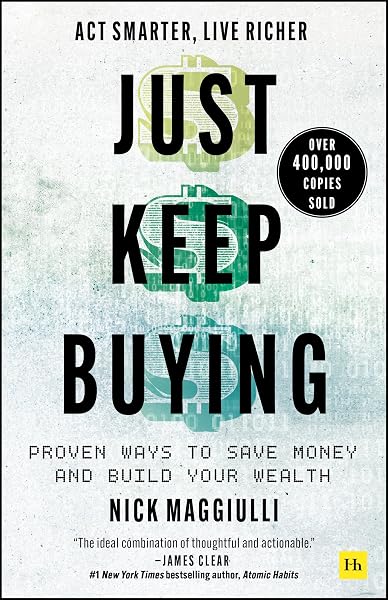
Personal finance decisions tested against actual market data instead of folklore. The answer to most timing questions turns out to be: buy regularly and stop watching.
Data instead of folklore
Most personal finance advice is a mixture of tradition, moralising, and things that sounded reasonable to someone once. Maggiulli's method is to take each claim and test it against market history.
That method produces several answers that contradict the standard advice, and a few that confirm it more strongly than the folklore ever did.
You cannot save your way to wealth
Saving is bounded. At best you can save everything you earn, and then you are still limited by your income. Investing is unbounded, because compounding has no natural ceiling.
The practical consequence is that saving is the foundation and investing is the engine. A person who saves aggressively and keeps the money in cash will be overtaken by a person who saves less and invests consistently, given enough time.
Stop waiting for the dip
The most useful chapter is on lump sums versus gradual investing. The intuition says to hold cash and buy after a fall. The data says the market rises more often than it falls, so waiting usually means buying higher or never buying at all.
His conclusion is blunt: invest when you have the money. If spreading it out helps you sleep, that is a reasonable compromise, but recognise it as an emotional accommodation rather than an optimisation.
Income beats frugality
Frugality has a hard limit — you can only cut so much. Income has no such limit, and a raise compounds through every future saving decision.
This does not mean spending freely. It means the highest-return financial project for most people under forty is not a cheaper phone plan but a better-paid job, and the effort spent optimising small expenses is often misallocated.
Why rich people do not feel rich
A chapter on the psychology of enough. People compare themselves to their neighbours and colleagues, so rising income tends to raise the reference point rather than the sense of security.
Combine that with lifestyle creep and you get the pattern the book keeps returning to: income rises, spending rises with it, and the savings rate stays flat. The raises were real, the progress was not.
Buying a home, honestly
The rent-versus-buy analysis is refreshing because it refuses to give a universal answer. The numbers are closer than either camp admits, and the decision hinges on how long you stay and what else you would do with the money.
His framing is that a house is a consumption good that sometimes appreciates, not an investment that happens to have walls.
Where the book is honest
Maggiulli is careful to say that his data covers American markets over specific periods, and that the past is not a guarantee. He also admits where the evidence is thin and where he is giving an opinion rather than a result.
That honesty is what makes the recommendations usable. You can see which ones are backed by decades of data and which are judgement calls.
The bottom line
Save what you can, invest it immediately and repeatedly, grow your income on purpose, and watch the creep. The strategy is almost boring, which is precisely why it works — and why so few people follow it.
🔑 Key actionable ideas
- You cannot save your way to wealth. Saving has a floor at zero; investing has no ceiling.
- Do not hold cash waiting for a dip. Time in the market beats timing the market, and the data is unambiguous.
- Growing your income usually beats cutting your expenses for building wealth, because expenses have a limit and income does not.
- Your human capital — your ability to earn — is your biggest asset when you are young, and it should be protected accordingly.
- Lifestyle creep is the silent killer: raises absorbed by spending feel like progress and leave you exactly where you were.
Who is this book for?
Readers who want their financial decisions backed by evidence rather than sayings, and younger investors deciding where to put their effort.
Final verdict
A well-argued, data-first personal finance book with unusually clear thinking about timing and income. It covers familiar ground, but the evidence changes several conclusions in useful ways.