Die With Zero
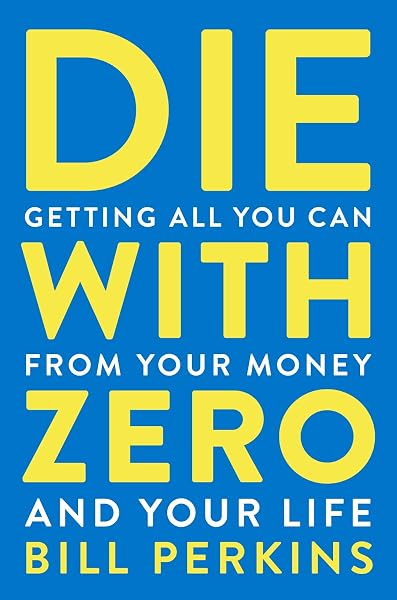
The goal is not to die rich. It is to convert money into experiences while you still have the health to enjoy them — and to spend the last dollar on the last day.
The question nobody asks
Most financial advice answers one question: how do I end up with as much money as possible? Perkins asks a different one. If money exists to be spent on a life, what is the optimal schedule for spending it?
The answer his title gives is uncomfortable. You should aim to die with roughly nothing, because every dollar left over represents either an experience you skipped or time you spent working for a reward you never collected.
Memory dividends
Perkins argues that experiences behave like an asset class with one unusual property: they pay dividends for the rest of your life. A trip lasts two weeks and then continues to pay out in recollection, conversation, and the way it changed you.
A larger house pays no such dividend. It is consumed continuously and remembered barely at all. This is why the same money spent on experiences usually produces more total satisfaction than the same money spent on things — and why deferring experiences is so costly.
The expiry date
The central insight of the book is that experiences are time-sensitive in a way that money is not. Backpacking through a country at twenty-two and at seventy-two are different products. Climbing, late nights, physical travel, and the willingness to be uncomfortable all decay.
Money, by contrast, can be saved indefinitely. So the rational move is to spend money on the experiences that are decaying while you still can, and to save for the ones that will still be available later. Almost nobody does this, because saving feels virtuous and spending feels indulgent.
The fulfilment curve
Perkins borrows a curve from behavioural economics. Money buys wellbeing up to a point, then the returns flatten, then they turn negative — because the pursuit of more starts costing health, relationships, and time.
The implication is that there is an optimum, and it is not "as much as possible". Beyond the optimum, extra earning is not neutral. It is actively purchased with things you cannot buy back.
Health, time, and money
The book frames a life as three resources that peak at different ages. Health declines steadily. Time is fixed. Money typically peaks late. The art is to trade money for experiences at the moment when health and time are still available to enjoy them.
This is why the standard advice to save everything for retirement is, in Perkins's view, a category error. You arrive at retirement with the most money and the least capacity to use it.
Giving while alive
The most practically useful chapter is about inheritance. A typical estate plan transfers wealth at the heirs' least useful moment. A person in their sixties receiving an inheritance has usually already bought a house, raised children, and settled into a career.
Perkins argues for giving earlier and in smaller amounts, when the money changes what is possible. He calls it giving with a warm hand. The same total, delivered earlier, buys far more life.
What this is not
It is worth being honest about the limits. Perkins made his money as a hedge fund trader, and some of the advice assumes a level of security most people do not have. The book is also repetitive, and the maths is illustrative rather than rigorous.
But the core correction is sound and rare. Most personal finance writing optimises accumulation and treats spending as a failure of discipline. This book treats spending as the entire point, and asks you to schedule it properly.
The bottom line
Decide what your money is for, notice which experiences expire, and stop deferring them in the name of a number you will never spend. Save enough to avoid becoming a burden, insure the catastrophes, and then use the rest while it can still buy you a life.
🔑 Key actionable ideas
- Wealth has no purpose in itself. Its only use is to be converted into experiences, and experiences have expiry dates.
- Optimising for the biggest possible number at death is a failure, not a success — you worked for money you never used.
- Experiences pay "memory dividends": the trip is over in a week and keeps paying for decades.
- Give money to your children while they need it, not after you die. An inheritance at sixty is worth far less than help at thirty.
- The balance is the point: do not over-save and under-live, and do not under-save and become a burden. Aim for zero at the end.
Who is this book for?
Over-savers, late-career professionals who have saved diligently and never spent, and anyone who suspects the standard retirement advice has quietly cost them years.
Final verdict
A genuinely counter-cultural argument that most personal finance books avoid, weakened by a privileged vantage point and a padded middle. The central idea is worth the read even if you discount the edges.