The Pragmatic Programmer
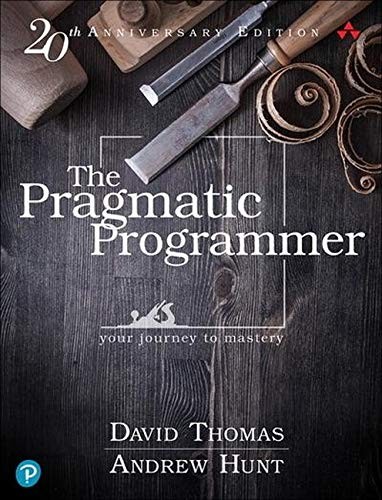
Hunt and Thomas distil decades of hard-won craft into practical habits: stay curious, keep code honest, automate the boring parts, and own your work.
The Core Idea
This is not a book about a language or a framework. It is about the habits that separate a careful craftsman from someone who merely gets code to run. Hunt and Thomas treat programming as a craft with principles that outlast every technology cycle, and they write as working engineers rather than theorists. The result is a set of durable attitudes you can carry from job to job while the tools around you change beyond recognition, and the book’s staying power after decades is itself the strongest argument for its advice. Its lessons are not tied to any language or platform, which is exactly why they keep working.
Take Responsibility
The first theme is ownership. Provide options rather than excuses, and do not blame tools, teammates or the compiler for a problem you can influence. A pragmatic programmer fixes things and does not leave them broken, and is honest about what is known and what is a guess. Owning your work also means disagreeing well: raising concerns early, presenting alternatives, and avoiding the passive resentment that quietly poisons teams and turns small frustrations into permanent damage. That kind of honesty is uncomfortable at first and invaluable later.
DRY and Orthogonality
Two structural ideas recur throughout. DRY — do not repeat yourself — pushes each piece of knowledge into one authoritative place, so a change happens once and cannot leave stale copies behind. Orthogonality asks that separate concerns stay separate, so a change in one area does not ripple unpredictably through the rest of the system. Together they keep software comprehensible as it grows and make accidental damage far less likely, which is why the authors treat them as habits rather than as one-time design decisions.
Flexible and Honest Systems
The book is full of small, durable practices that keep software adaptable over years of change, and most of them cost nothing to adopt once you have internalised them.
- Prefer plain text for data that should outlive your tools, because readable formats survive.
- Build tracer bullets: a thin end-to-end slice that proves the system works before you scale it.
- Prototype to learn, then throw the prototype away instead of promoting it.
- Program deliberately, never by coincidence, and understand why the code works.
- Fix the broken windows before decay spreads and invites more neglect.
Tools, Testing and Estimation
The authors urge automating anything you do repeatedly, treating testing as a first-class activity rather than an afterthought, and approaching estimation with humility — every estimate is a guess, so refine them as you learn. Documentation written as you go, they note, saves far more time than it costs, and a well-kept project is one a stranger can run without a phone call to its author. Convenience for the next person is a design goal, not a luxury, and the shortcuts you take today are the emergencies your successor inherits tomorrow. A team that writes things down spends its energy on building rather than on remembering.
A career is an investment portfolio too. Keep learning deliberately, diversify your skills, and revisit older knowledge before it depreciates. The advice is to invest regularly, even in small amounts, so that competence compounds the same way money does. The point is not to chase every new trend, but to stay genuinely curious and to keep the fundamentals sharp while the fashionable details come and go, because the people who stay valuable are usually the ones who kept learning long after the tutorial ended and the novelty wore off.
Honest Limits
Some examples and tool references have aged, and the short, aphoristic tips occasionally oversimplify problems that need judgement and context. The book also assumes a workplace where engineers have real autonomy, which is not universal, and its advice can read as obvious to anyone who already works on a well-run team. The newer edition updates the technology while keeping the philosophy intact, which is a good sign of how little the underlying ideas depend on any particular stack. Even so, the principles remain remarkably durable — this is one of the few programming books worth revisiting every few years, because you will notice different things each time.
🔑 Key actionable ideas
- Take ownership; provide options, not excuses.
- Keep knowledge in one place and keep concerns separate.
- Let prototypes teach you, then discard them.
- Automate repetitive work; test as you build.
- Treat estimates as guesses and refine them over time.
- Invest continuously in a diverse knowledge portfolio.
- Watch for broken windows — small decay invites more.
Who is this book for?
Working and aspiring developers who want to grow beyond framework knowledge into durable craftsmanship, and teams looking for shared habits and vocabulary.
Final verdict
A rare evergreen classic whose craft principles outlast every technology in it. Dated examples, timeless habits — essential reading for serious developers.