The Phoenix Project
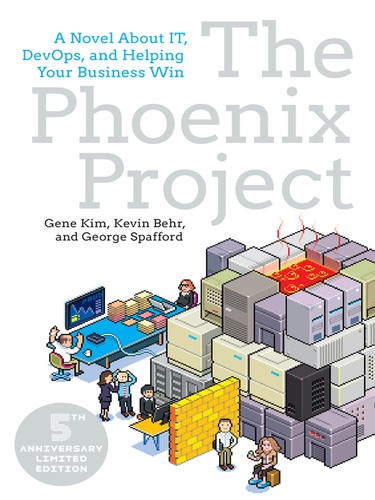
A business novel that turns a failing IT department into a gripping rescue story — and teaches the flow, constraint and feedback principles that save it.
The Core Idea
The book teaches through a novel. Bill Palmer, a capable middle manager, is handed control of an IT department that is failing in public: a business-critical project is late, an audit is looming, systems keep breaking, and every fix seems to create two new problems. His journey from drowning to leading becomes a practical framework for anyone who works inside a tangled technology organisation, and the story is engineered so that each mistake and insight lands as drama rather than as a lecture.
The authors borrow deliberately from manufacturing, arguing that an IT department is really a factory that produces changes, and that the same thinking which transformed physical production can transform software delivery. That analogy carries the whole book. It also supplies the vocabulary — flow, constraints, work in progress — that has since become standard in conversations about DevOps and platform engineering, even among people who never read it here first.
The Three Ways
The book organises its ideas into three movements. Flow makes work move smoothly from request to release and stops half-finished work from piling up. Feedback shortens the loop between doing something and learning whether it worked. Continuous learning builds a culture where experiments and mistakes are treated as information rather than as crimes. Each movement answers a different failure mode, and the order reflects how teams usually heal: first the flow, then the feedback, then the culture that keeps both alive.
Work in Progress Is the Enemy
Bill's first breakthrough is almost embarrassingly simple. The team is drowning not because it is lazy but because it starts far more work than it finishes, and half-built features and forgotten tickets clog every hand-off. Limiting work in progress is the single change that lets the system breathe. The novel then separates work into business projects, internal IT projects, changes generated by those projects, and the category everyone ignores — unplanned work caused by failures. Unplanned work is the silent thief, stealing capacity from planned work until haste produces more outages, which produce more haste.
Constraints, Bottlenecks and the Brent Problem
A gifted engineer named Brent becomes the story's central metaphor. He is the only person who can fix certain things, so everyone routes work through him and he becomes the bottleneck that caps the whole company. The lesson is that a constraint anywhere in the flow limits throughput everywhere, and that protecting the bottleneck matters more than keeping every other station busy. It is a vivid restatement of an old operations idea, and it explains why the busiest person in an organisation is often the reason nothing ships on time.
Change, Risk and Execution
The audit plot gives the book a second argument: control and speed are not opposites. By making changes smaller, more visible and more automated, the team can satisfy a compliance auditor while deploying more often, not less. The fear that discipline will slow you down is usually the thing slowing you down. The later chapters push toward small batches, automation and production-like testing so problems surface early and cheaply, and toward a culture where bad news can travel upward without punishment.
Outcomes, Trust and Culture
The transformation is measured in business terms rather than engineering pride: shorter delivery times, fewer outages, and a management team that finally trusts technology. Bill learns to speak the language of the executives who control his budget, which is perhaps the most transferable lesson in the book. Software delivery improves when the people paying for it understand it as a flow of value rather than a mysterious cost centre, and that understanding has to be built deliberately through visible wins and honest reporting.
A Fair Critique
The dialogue can feel staged and the characters are drawn broadly, and a sceptical reader may find the novel-form lessons simplified next to the mess of a real enterprise. The manufacturing analogy also stretches thin in places, and the ending is warmer than most real transformations. But as an introduction to how development, operations and business fit together, it is unusually memorable: you keep the story long after the diagrams fade.
🔑 Key actionable ideas
- Limit work in progress; finishing beats starting.
- Treat IT as a flow of value, not a queue of tickets.
- Unplanned work is the hidden cost that starves everything else.
- Find the bottleneck and protect it from distraction.
- Smaller, automated changes are safer than rare big ones.
- Shorten the feedback loop between change and learning.
- Build a culture where bad news travels fast and safely.
Who is this book for?
Developers, operations engineers and managers in technology organisations, plus anyone frustrated that their team works hard yet never seems to catch up.
Final verdict
A teaching story rather than a technical manual, and a memorable one. Read it for the mental model of flow and constraints, then go find the practical detail elsewhere.