The Mom Test
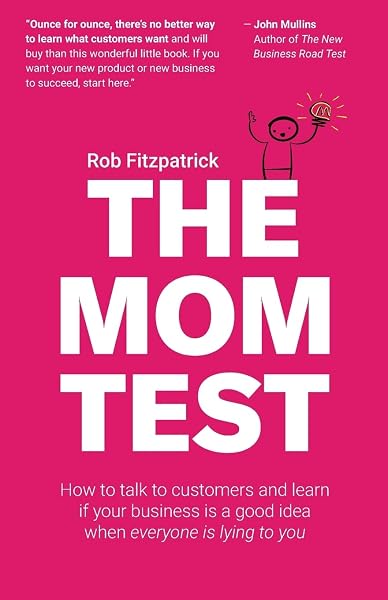
How to talk to customers and learn the truth about your idea. Short, funny, and quietly brutal about how badly most people run customer conversations.
Why the question is broken
The instinct when you have an idea is to describe it and ask what people think. Fitzpatrick shows why this is guaranteed to mislead: the moment you describe your idea, you tell the other person what answer you want, and most people will give it to you to be kind.
His mother is the extreme case, hence the name, but investors, colleagues, and strangers do the same thing with less warmth. The person who says "that sounds great" is not lying. They are being socially competent.
Ask about their life instead
The fix is to stop talking about your idea and start asking about their world. What were they doing when this problem last came up? What did they do about it? What did that cost them?
These questions have real answers, and real answers are evidence. If the problem is genuinely painful, people already have a workaround, a spreadsheet, or a complaint. If they do not, the problem may be one you invented.
Good questions and bad questions
Fitzpatrick gives a long list of bad questions — "would you buy this?", "how much would you pay?", "do you think this is a good idea?" — and shows what each one actually measures. Mostly, they measure politeness.
Good questions are about specifics of the past. How much did that cost you last year? Who else was involved when you tried to fix it? What happened then? Past behaviour is the only data you have, and it is available for free.
The danger of the wrong data
Bad conversations are worse than no conversations. They take time, they produce a warm feeling, and they can convince you to build something nobody wants. Fitzpatrick treats premature validation as the most expensive mistake in the whole process.
His test for whether a conversation was useful is simple: did you learn anything that could make you change your plan? If the answer is no, you were not gathering data, you were gathering comfort.
Commitments, not opinions
The strongest section is on how to end a conversation with something that costs the other person. Not a signature, necessarily — but an introduction to someone else, a scheduled follow-up, a deposit, a promise to be an early tester.
If a conversation cannot produce a small commitment, it is a strong signal that the problem is not urgent. That information is valuable and it arrives early, before you have built anything.
Where this fits
The book is short — under a hundred and fifty pages — and it is really a procedure. It is not about market research at scale. It is about the twenty conversations you have before you write code, which is where the decision is actually made.
Fitzpatrick is honest that his method slows you down at the start. That is the point. The time you lose is small compared to the time you save by not building the wrong thing.
The bottom line
People will not tell you the truth about your idea if you ask them directly. So do not ask them about your idea. Ask about their lives, listen for problems that already hurt, and trust only what they have already done — or are willing to commit now.
🔑 Key actionable ideas
- You should not ask your mother whether your business is a good idea. She loves you, so she will lie — and everyone else lies a little too.
- Never ask whether someone would buy your idea. Hypotheticals produce polite fiction, not evidence.
- Ask about their life and their past behaviour, not your product. What did you do last time this problem came up?
- Compliments are noise. If a conversation produces praise and no facts, it produced nothing.
- A real commitment — time, reputation, or money — is the only signal that means anything.
Who is this book for?
Founders, freelancers, and anyone validating a product or service idea. Also useful for people who want better conversations in general.
Final verdict
One of the highest-value short books in the business canon. It is informal and occasionally repetitive, but the core procedure is genuinely counterintuitive and it changes how you talk to people.