The Little Book That Still Beats the Market
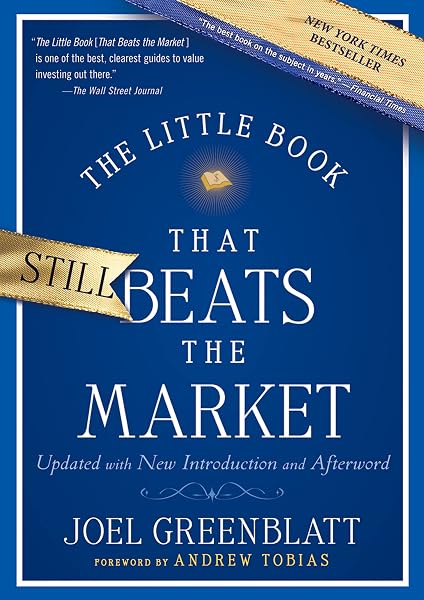
A simple, mechanical formula for buying above-average companies at below-average prices — and the uncomfortable reason most people still fail at it.
The problem with "good and cheap"
Everyone agrees you should buy good companies at cheap prices. The difficulty is that those two qualities are usually opposites: wonderful businesses are expensive, and cheap businesses are usually cheap for a reason.
Greenblatt's contribution is a rank-based formula that combines both, so you do not have to guess which quality matters more.
The magic formula in two ranks
Rank every company in your universe twice.
Rank one: return on capital. How much profit does the business generate on the money tied up in it? A high return on capital means the business is genuinely good — it earns a lot without needing a lot.
Rank two: earnings yield. How much profit do you get for the price you pay? This is simply the inverse of the price-to-earnings ratio.
Add the two ranks together. Buy the companies with the best combined rank. Hold each for about a year, then re-rank and replace the ones that dropped out.
Why combining them works
Each rank alone has a fatal flaw.
- Return on capital alone leads you to wonderful businesses at terrible prices.
- Earnings yield alone leads you to statistically cheap businesses that are cheap because they are deteriorating.
Requiring both keeps you away from both traps, and it does so without requiring any forecast about the future.
The reason it keeps working
Greenblatt's explanation is not that markets are inefficient in general, but that this specific combination is uncomfortable to hold.
When you sort for high return on capital and high earnings yield, you get boring, unloved, often small companies in unglamorous industries. They will be firms you have never heard of, and some of them will look obviously bad.
Most professionals cannot buy them at scale, and most individuals will not hold them through a bad year. That behavioural gap is where the return comes from.
The behaviour problem
The book's real subject is patience. The formula will underperform the market for stretches of several years — that is expected, not a malfunction.
Greenblatt's honest warning: the person most likely to fail with this method is one who adopts it after seeing strong past returns, then quits during the first long dry spell.
What it does not do
- It is not a complete portfolio. It is a stock-selection rule, not a plan for asset allocation.
- It ignores taxes and costs in the simple version, though the book discusses both and suggests running the formula inside a tax-advantaged account where possible.
- It says nothing about position sizing or risk tolerance, which remain your responsibility.
- It works on average, not always. Individual picks will fail; the method is designed to work across many of them.
A fair critique
Some findings have weakened as the idea became widely known, and small-cap stocks carry real liquidity risk. Treat the formula as a well-explained example of a systematic approach — the transferable lesson is the discipline of ranking, diversifying and waiting, not the two ratios themselves.
🔑 Key actionable ideas
- Rank companies twice: by return on capital and by earnings yield.
- Add the ranks and buy the best combined scores.
- Requiring both qualities avoids both expensive quality and cheap junk.
- The advantage persists because the resulting portfolio is uncomfortable to hold.
- Expect multi-year periods of underperformance — they are part of the design.
- Be honest about whether you can hold through a bad stretch before you start.
- The real lesson is systematic discipline, not the two specific ratios.
Who is this book for?
Beginners who want to see how a systematic stock strategy is actually built, and anyone curious why simple rules survive in markets.
Final verdict
Short, clear and honest about its own weaknesses. Best read as an introduction to systematic investing rather than as a formula to apply blindly.