Quiet
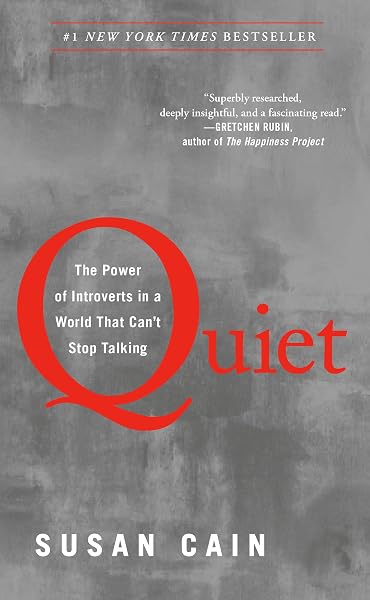
A third of people are introverts, and modern culture is built as though they are a problem to fix. A calm, well-researched case for the other half of the room.
The other third
Cain opens with a statistic and a complaint. Roughly a third to a half of people are introverts, and yet the institutions of modern life — schools, workplaces, leadership models — are designed as though extroversion were the norm and introversion a deficiency.
The complaint is not that extroverts are bad. It is that a temperament has been quietly reclassified as a personality defect, and that the reclassification costs both individuals and organisations real capability.
Two different things
The most useful clarification in the book. Shyness is about fear of social judgement. Introversion is about where you get your energy and how much stimulation you prefer.
You can be an introvert who is not shy at all — comfortable speaking, but drained by a day of meetings. You can also be an anxious extrovert. Confusing the two is why so much advice for introverts is really advice for shy people.
The Extrovert Ideal
Cain traces the shift historically. Nineteenth-century America valued a culture of character: seriousness, discipline, duty. By the twentieth century it had become a culture of personality: magnetism, confidence, the ability to sell yourself.
The rise of the self-help industry, the job interview, and the sales economy all pushed in the same direction. The result is a cultural assumption that the loudest person in the room is the most capable, which is not supported by much evidence.
The trouble with brainstorming
A chapter that has since become widely cited. Group brainstorming feels productive and is measurably worse than the same number of people working alone and pooling their ideas.
The reasons are social: the first speaker anchors the discussion, quieter members defer, and the pressure to appear agreeable suppresses the disagreements that generate good ideas. Cain is careful to say that collaboration is valuable — but that it works best with preparation and asynchrony rather than in a room.
Restorative niches
A term borrowed from personality psychology. Introverts do not need solitude because they dislike people; they need lower stimulation to recover, the way anyone needs sleep.
The practical advice is to identify your niche deliberately — a walk, a closed door, a quiet commute — and to protect it rather than treating the need as weakness.
Free trait agreement
The most liberating idea in the book. An introvert can act extroverted for a period, and it works best when the reason is something they care about — a cause, a person, a piece of work.
The cost is real and should be budgeted: recovery time afterwards. But it means introversion is not a fixed limit on what you can do, only on how long you can sustain it without paying.
Where the argument is weakest
Cain is sometimes criticised for over-generalising from vivid anecdotes, and the book does lean heavily on individual stories. The sensitivity research is more solid than the cultural history.
She also makes an effort not to become anti-extrovert, and the closing sections on partnership argue that the two temperaments genuinely complement each other rather than one being superior.
The bottom line
Introversion is a temperament, not a deficiency, and a culture that treats it as one wastes a large share of its talent. Know your own stimulation needs, protect your recovery, and spend your out-of-character effort only on things that matter.
🔑 Key actionable ideas
- Introversion is not shyness. Shyness is fear of judgement; introversion is a preference for lower stimulation.
- The Extrovert Ideal is a cultural bias, not a law of nature — and it shapes hiring, schooling, and office design.
- Groups produce fewer and worse ideas than the same individuals working alone, despite the confidence we place in brainstorming.
- Every introvert needs a restorative niche — a place or period of low stimulation to recover.
- Acting out of character is possible and sometimes worth it, but only for something you genuinely care about, and it costs energy.
Who is this book for?
Introverts who have been told their temperament is a problem, managers who run teams, and parents of quiet children.
Final verdict
A persuasive and well-timed corrective that gave a lot of people language for something they knew but could not name. The evidence is stronger in the psychology than in the history, but the central case holds.