Predictably Irrational
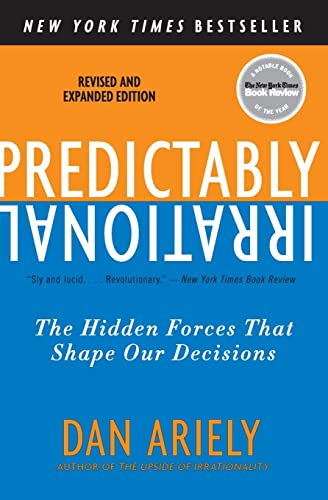
Why smart people make the same predictable mistakes with money, time and each other — and what the experiments reveal about the machinery underneath.
The Core Idea
Ariely does not argue that people are stupid. He argues that they are predictably irrational: their mistakes follow patterns, and those patterns can be demonstrated in experiments. That distinction matters. A random error cannot be studied or designed around; a systematic one can.
The book collects experiments in which ordinary people reliably choose in ways that contradict their own stated preferences. The point is not to laugh at the subjects. It is to notice that the same machinery is running every time you compare prices, answer an email, or promise yourself you will start tomorrow.
Relativity: we almost never judge in absolute terms
One of the book's central demonstrations is that preferences are often constructed at the moment of choice. When a third, unattractive option is added to a pair, people's choice between the original two can flip. The new option was never going to be chosen; its job was to make one of the others look better.
This is the decoy effect, and its practical lesson is uncomfortable: if your preference can be reversed by an option you would never pick, the preference was not as stable as you thought. Asking "would I still want this if the alternatives were different?" is a useful check before a large purchase.
Arbitrary coherence
Ariely describes experiments in which an arbitrary starting value — a number with no information behind it — shapes what people subsequently consider reasonable. Once an anchor is in place, adjustments away from it are typically too small.
The name captures the mechanism: an arbitrary input becomes a coherent preference. In negotiation, this is why the first number on the table matters even when everyone knows it is a position rather than a fact. The defence is not to argue about the anchor but to generate your own independently, before you hear theirs.
The magic of zero
Zero is not merely the bottom of the price scale. It behaves like a category boundary. A price that drops from something small to nothing produces a disproportionate jump in demand, and the attraction of "free" can override a straightforward comparison of total costs.
Ariely's examples include choices where the free option carries a small unavoidable cost — shipping, effort, a worse product — and people still take it. The lesson is not "never choose free". It is to price the whole outcome and ignore the label.
Social norms versus market norms
Some relationships run on favours, goodwill and obligation. Others run on payment. Mixing them can change which one you are in, and changing back is difficult.
The book discusses settings where introducing a monetary penalty to a social situation made the behaviour worse rather than better: a fine for late collection turned a social obligation into a fee, and after the fine was removed the behaviour did not return to the earlier level. The norm had been displaced.
The practical version applies to teams and families: be careful about what you put a price on. Once a relationship is framed as a transaction, goodwill is no longer the currency.
Expectations change experience
Price is not only a cost; it is also a prediction. Ariely describes experiments in which the same product was rated differently depending on the price people believed they were paying. The higher-priced version produced a better experience, even when the underlying item was identical.
This is not simply snobbery. Expectations shape attention, and attention shapes perception. Brands pay for that effect, but the individual version is more useful: if you know a high price can improve the experience, you can also see when you are paying for the story rather than the thing.
Hot and cold states
The final section turns to self-control. In a cold state we make plans; in a hot state we act. The plan assumes the cold state will be in charge when the moment arrives, and it usually is not.
Ariely argues for commitment devices: make the future action inconvenient or impossible rather than relying on a promise to yourself. Automatic savings, removing the app, giving someone else the decision — these work because they change the situation, not the intention.
A Fair Critique
The experiments are vivid and the framing is memorable, but the book writes with more certainty than every result can carry. Several studies in this area came from an era before large pre-registered replications became standard, and some effects in behavioural science have since shrunk or failed to replicate in other settings.
That does not erase the pattern — anchoring and the power of zero are robust enough to design around — but it is a reason to treat any single experiment as an illustration rather than a law. It is also worth saying that the book is organised around surprises rather than a single theory, so readers looking for one unifying model will not find it.
The Bottom Line
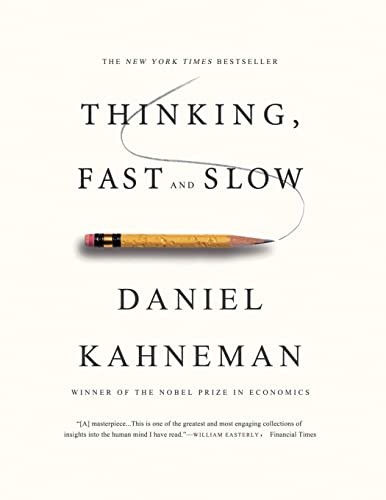
Read it as a set of questions to ask at the moment of decision: what is this being compared with, where did the first number come from, am I reacting to the word "free", and which norm am I in? The value is not in knowing the experiments. It is in noticing the machinery while it is running. Thinking, Fast and Slow gives the wider theoretical map, and Psychology of Money shows how the same biases play out with real savings.
🔑 Key actionable ideas
- We judge value by comparison, not in absolute terms. The same object feels better or worse depending on what sits next to it, which is why a decoy can reverse a preference.
- An arbitrary number can anchor what we are willing to pay. The starting point has no logical authority, but it shapes the answer anyway.
- Zero is not just a small number. "Free" produces a jump in demand that a tiny price does not, and it routinely makes people choose the worse deal.
- Social norms and market norms do not mix well. Paying someone for a favour can push the relationship into a market frame that is hard to undo.
- Expectations change experience. A higher price can make the same product taste better, because the price sets a prediction the brain then confirms.
- We plan in a calm state and act in a hot one. Commitment devices work not by increasing willpower but by removing the moment of decision.
Who is this book for?
Readers who want concrete experiments rather than theory, and anyone who makes pricing, negotiation or budgeting decisions and wants to know where their judgement bends.
Final verdict
A lively, experiment-led tour of the quirks in everyday judgement. The examples are far more durable than the confident conclusions drawn from some of them — take the questions, not the certainty.