Four Thousand Weeks
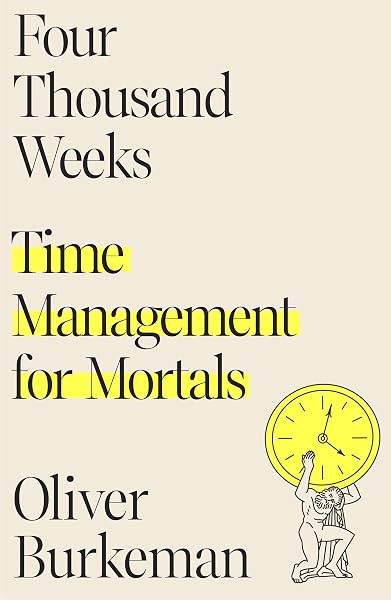
An eighty-year life is about four thousand weeks. This is a time-management book that argues the backlog will never be cleared — and that accepting this is the only way to live.
The arithmetic
Four thousand weeks is roughly the number of weeks in an eighty-year life. Burkeman puts it at the front because the number is small enough to feel, and because the entire book follows from taking it seriously.
If time were abundant, the standard productivity project would make sense: optimise, clear the backlog, and eventually get on top of things. Since time is finite, that project cannot succeed by definition.
The efficiency trap
The core argument is that productivity systems are self-defeating. Clearing tasks faster does not produce free time; it produces more tasks, because the supply of possible work expands to fill the capacity available.
This is why people who become more efficient often feel busier. They have increased their throughput and their commitments have risen to match. The promise of the system was leisure, and the delivery was a larger workload.
The fantasy of the finished list
Burkeman is merciless about the underlying assumption that one day the list will be done. It will not, and treating that as a temporary failure keeps you in a permanent state of inadequacy.
The alternative is to accept the list as endless, and then decide — consciously, in advance — which few things deserve the finite time you have.
Cosmic insignificance therapy
One of the more unusual and more useful chapters. Burkeman argues that recognising your own smallness is consoling rather than depressing.
If your work is not as consequential as you feel it must be, then the pressure to justify your existence through output is released. A great deal of anxious productivity is driven by the belief that the stakes are higher than they are.
Settling
A chapter on commitment. Every choice forecloses alternatives, and the modern instinct is to keep options open as long as possible to avoid the loss.
Burkeman argues the opposite: the willingness to settle on something, and accept what it costs, is what allows anything to matter. Keeping your options open is itself a choice, and usually the emptier one.
Attention and the present
The later chapters turn to what time is actually for. He argues that the quality of a life is largely the quality of attention within it, and that constant availability fragments attention into something that cannot appreciate anything.
The practical suggestions that follow are modest and unglamorous: fewer commitments, deliberate boredom, single-tasking, and the willingness to be unavailable.
The joy of missing out
Burkeman reframes FOMO. Since you cannot do everything, missing out is not a failure mode — it is the permanent condition, and the only question is whether you are choosing what to miss.
Deliberate neglect becomes a discipline rather than a confession. The people who seem to do meaningful work are usually people who have become comfortable saying no to a great deal.
The bottom line
You have about four thousand weeks and no system will make them enough. Stop treating that as a problem, decide what deserves the time you have, protect your attention, and accept that the rest will go undone — which is what was always going to happen.
🔑 Key actionable ideas
- You will never get everything done. The inbox refills, the list grows, and productivity advice that promises otherwise is selling a fantasy.
- Efficiency applied to life is corrosive: the faster you clear work, the more work appears to fill the space.
- Finitude is not a problem to solve. It is the condition that makes any choice meaningful.
- Choose what to neglect deliberately, rather than pretending everything can have a place.
- Attention is the real currency. A life spent distracted is a life spent somewhere else.
Who is this book for?
Anyone exhausted by productivity systems, and readers who suspect that getting more efficient has not made their life feel larger.
Final verdict
A rare book in its genre: philosophically serious and genuinely comforting rather than motivating. It offers few techniques by design, which will frustrate readers wanting a system.