Dollars and Sense
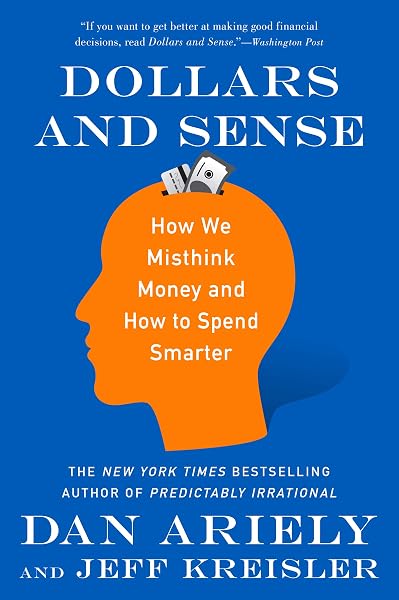
Money decisions are emotional, not mathematical. A behavioural economist shows why the price tag is a story we tell ourselves, and how to spot the tricks your own brain plays.
The price tag is a story
We have no way to feel what most things are worth. A television does not produce a physical sensation of value, so instead of judging absolute worth we compare — and almost anything can be made to look like a bargain or a rip-off depending on what sits next to it.
This is why restaurants list an absurdly expensive dish nobody orders. Its job is not to be sold. Its job is to make the second-most-expensive dish look reasonable. The expensive item is a reference point, and the middle item is the product.
Why cash feels different
The pain of paying is real enough to show up in brain scans. Cash is the most painful form because you watch it leave. A card is less painful. A saved card number you never look at is barely painful at all.
Every layer of separation between the purchase and the moment of paying lowers the pain, and lower pain means more spending. That is the business model of one-click checkout, buy-now-pay-later, and the digital wallet.
Free is not zero
Ariely ran an experiment with two offers: a one-dollar chocolate and a free cheaper chocolate. When both cost something, people mostly chose the better one. When the cheaper one became free, people stampeded to it, even though the better chocolate was then a fraction of its usual price.
Free does not change the price. It changes the decision. Free removes the risk of regret, and regret turns out to be the thing we are actually avoiding. This is why free shipping outsells a discount that leaves the total lower.
Anchoring and relativity
The first number we see becomes the anchor for every number after it. A salary offer anchors a negotiation. A sticker price anchors what feels like a fair discount. Once an anchor is set, adjustments from it are small and reluctant.
The practical consequence is that whoever names a number first has an advantage, and that a badly chosen reference point can make an expensive decision feel reasonable for years.
What to do about it
None of this is a moral failing. It is how attention works, and it is strongest exactly when you are deciding, which is the worst moment to rely on discipline.
Ariely's advice is to decide in advance. A waiting period for anything above a set amount. A written weekly limit that does not move. A single question — what else would this money do? — asked out loud. Rules beat willpower because rules are made when your judgment is clear and applied when it is not.
The bottom line
Money is emotional, and the tricks are predictable once you know them. You will not out-discipline them in the moment. You can out-plan them beforehand, which is the only approach that reliably works.
🔑 Key actionable ideas
- We judge prices relative to whatever number is nearby, not by what the thing is actually worth.
- Paying with plastic hurts less than paying with cash, which is why card spending escapes every budget.
- A sale makes the discount the story; you did not save 30 percent, you spent 70 percent you had not planned to spend.
- Free is not a low price, it is a different category, and it removes the fear of regret rather than the cost.
- The defense is a rule made in a calm moment: a waiting period, a written limit, a question asked before the purchase.
Who is this book for?
Anyone who has ever wondered why their spending does not match their intentions, and readers who want the behavioural economics of money without the academic density.
Final verdict
A genuinely useful book on the psychology of spending, written with more humour than the genre usually manages. The research is solid and the advice is practical, though the second half repeats the first at greater length.