Against the Gods
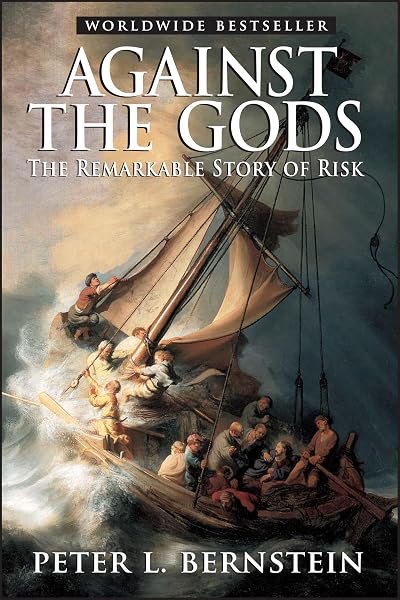
The history of how humanity learned to think about risk — from dice games to insurance to derivatives. The book that explains why insurance exists and why your intuition about probability is so bad.
Before probability
For most of history the future was the domain of gods and fortune. Events were not random, they were decided. Dice were not instruments of chance, they were instruments of divine will, and the correct response to uncertainty was prayer or resignation.
Bernstein's insight is that the modern world only becomes possible once people accept that some events genuinely have no cause — that a coin has no memory and no preference. That idea took centuries to arrive, and it arrived first at the gambling table.
The gamblers did the mathematics
Cardano, a sixteenth-century physician and compulsive gambler, worked out the basic rules of probability to improve his own betting. Pascal and Fermat formalised them in a correspondence about splitting a stake when a game is interrupted.
This is the origin story of statistics: it was invented by people trying to win money, then handed to science. The order matters, because it explains why probability is so well suited to decisions under uncertainty and so awkward when applied to certainties.
Insurance: the first great invention
The breakthrough that turned probability into an institution was insurance. The insight is simple once stated: if a thousand people each face a small chance of ruin, they can pool their money so that the unlucky one is made whole. Nobody knows who will be unlucky, and it does not matter.
This is why insurance is not gambling. Gambling creates a risk that did not exist. Insurance transfers one that already did, and makes it bearable. Bernstein traces the idea from maritime shipping, where a lost ship ruined a merchant, to modern life and health cover.
Normal distributions and their limits
Gauss gave the world the bell curve, and for a century it seemed that most variation in the world was well behaved: cluster around an average, thin out symmetrically. Height, measurement error, and crop yields all fit.
Markets do not. Financial returns have far more extreme events than a bell curve predicts, which is why models built on normal distributions kept prescribing safe positions right up to the moment they blew up. Bernstein is blunt that the mathematics outran the humility.
Why we misjudge risk
The book's most practical chapter is on how badly humans handle probability. We weigh vivid, recent, and personal risks far more heavily than quiet statistical ones. We remember disasters, not rates.
This is why lottery tickets sell and why people fear the wrong things. It is also why insurance sales work: a vivid story, a neighbour who lost everything, moves people more than a table of figures ever will.
The lesson for a normal person
The useful takeaway is not a formula. It is that risk is something to be named, measured roughly, and then transferred or accepted on purpose — and that the feeling of certainty is usually the most dangerous part of any decision.
Bernstein ends on the idea that the story of risk is the story of progress, and that the danger is never uncertainty itself but the belief that we have eliminated it.
🔑 Key actionable ideas
- Risk is not fate. The idea that the future has a range of outcomes we can put numbers on is a surprisingly recent invention.
- Probability began with gambling, because gambling was the first place where people could see the same event repeat often enough to measure it.
- Insurance is the practical application of probability: many people pay a small certain amount so that no single person faces a catastrophic uncertain one.
- We systematically overestimate vivid, memorable risks and underestimate dull, statistical ones — which is why we fear flying and not driving.
- Every advance in finance has been a new way to measure or transfer risk, and every crisis has come from believing a measurement was more precise than it was.
Who is this book for?
Readers who want to understand where probability, insurance, and modern finance came from, and anyone who wants a genuine reason to distrust confident predictions.
Final verdict
A wide-ranging and elegantly written history that doubles as an argument about the limits of forecasting. The cast of characters is large and some middle chapters sag, but the central thesis is delivered convincingly.