Sapiens: A Brief History of Humankind
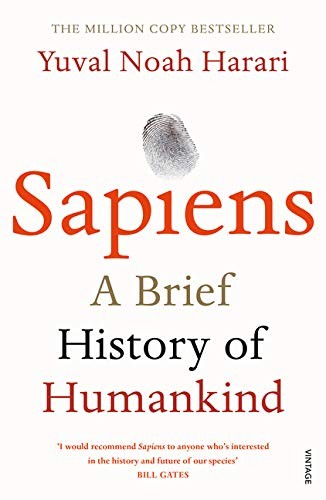
How did an unremarkable ape come to rule the planet? Harari traces the shared stories, farming traps and scientific leaps that built the modern world.
The Core Idea
Around seventy thousand years ago, Homo sapiens was one of several human species sharing the planet, and by most physical measures not an especially impressive one. Within a relatively short span, sapiens spread to every continent, the other human species disappeared, and ecosystems began to bend around one animal. Harari argues that strength, speed or even individual intelligence cannot explain that leap on their own.
His answer is storytelling at scale. Sapiens learned to speak about things that have no physical existence at all: gods, nations, money, companies, laws and human rights. Because thousands of strangers can believe the same story at the same time, they can cooperate flexibly, trade with people they will never meet, build cities, and follow shared rules. A chimpanzee troop is held together by personal knowledge. A human society is held together by shared imagination.
Language, in this account, did two jobs. It carried practical information about rivers, animals and danger, and it carried gossip, which let larger groups track reputations, cheaters and allies. More importantly, it let people create and revise collective fictions quickly. When a story changed, behaviour could change with it, without waiting for genetic change. That flexibility, rather than any single tool, is what let small bands become tribes, cities and eventually global networks.
The Agricultural Revolution
About twelve thousand years ago, humans began farming wheat, rice and other crops, and keeping animals in permanent settlements. The standard story calls this straightforward progress. Harari calls it a trap, and at times the worst mistake in the history of the species. Farming produced more food and therefore more people, but for the average person it often meant longer working hours, a narrower and less reliable diet, harder physical strain, and worse health than foraging had required.
Once a population depended on crops, returning to foraging was no longer realistic: there were simply too many mouths. Surpluses supported kings, priests, soldiers and clerks, and early writing emerged largely to record taxes, debts and property rather than poetry. In one of the most quoted framings in modern popular history, wheat did not simply serve humans. Humans reorganised their bodies, homes and calendars around wheat.
Money, Empires and Trust
Money is the clearest example of a useful shared story. A coin, a banknote or a number on a screen has value only because people who may share no language, religion or ruler agree to treat it as valuable. That agreement lets complete strangers trade with confidence, and credit extends the same trick into the future, funding voyages, factories and businesses on the expectation of growth that has not happened yet.
Empires receive a deliberately uncomfortable treatment. They were built through violence and exploitation, and Harari does not soften that record. At the same time, empires spread common languages, legal systems, currencies and roads, which made cooperation possible across enormous distances. He refuses to sort the past into simple heroes and villains, and notes that ideas spread by empire, including universal rights, were later turned against empire itself.
The Scientific Revolution
The final shift began roughly five hundred years ago, when scholars, states and investors began to admit ignorance in a productive way and to fund systematic inquiry into it. Science, empire and capitalism reinforced one another: discovery promised profit and military power, and profit and power paid for more discovery, better instruments and wider exploration.
The result was an acceleration with no earlier parallel: steam power, electricity, antibiotics, flight and computers, each arriving faster than the last. It also created a new problem. A species that can edit genes, design intelligent machines and alter the climate must decide what it actually wants, not merely what it is capable of doing. Harari closes by asking whether all this added power has made sapiens any happier, and finds the evidence surprisingly thin.
A Fair Critique
The sweep is both the appeal and the weakness. Specialists have challenged parts of the timeline, the sharp line drawn between sapiens and other human species, and the claim that farming was simply a mistake rather than a trade with winners and losers. Some arguments are stated with more confidence than the underlying evidence can carry, and a memorable framing is occasionally treated as if it were a settled explanation.
The discussion of happiness is thinner than the discussion of power, the later chapters move faster than the early ones, and readers looking for practical guidance will find almost none. None of that cancels the achievement, but it does mean the book works best read actively, with its boldest claims held up against other historians rather than accepted on style alone.
The Bottom Line
Read Sapiens as a map rather than a verdict. Its lasting value is the habit it teaches: whenever a large group of strangers cooperates smoothly, ask which shared story they are all believing, who benefits from that story, and what it costs the people and animals who stand outside it. Few popular history books change the questions you ask about ordinary things like money and nations. This one does.
🔑 Key actionable ideas
- Shared stories — money, nations, companies, laws — are what let thousands of strangers cooperate. Biology sets limits; imagination removes many of them.
- Farming was not simple progress. It fed more people while often making the average life harder, longer and less healthy.
- Money works because of collective trust, not because of anything in the coin or note itself. It is the most successful shared story humans have told.
- Empires spread violence and exploitation, and also the common languages, laws and currencies that made large-scale cooperation possible.
- Modern science advanced when societies admitted ignorance and funded the search for answers — and when profit and power paid the bill.
- More power has not clearly meant more happiness. Knowing what we can do is not the same as knowing what we should want.
Who is this book for?
Readers who enjoy big-picture history and want one readable book that connects biology, money, empire and science. It suits curious general readers more than specialists looking for footnoted detail.
Final verdict
A sweeping, highly readable account of how shared stories built the human world. The framing is brilliant and genuinely perspective-changing, even where specialists would add caveats — read it actively, not passively.