The Almanack of Naval Ravikant
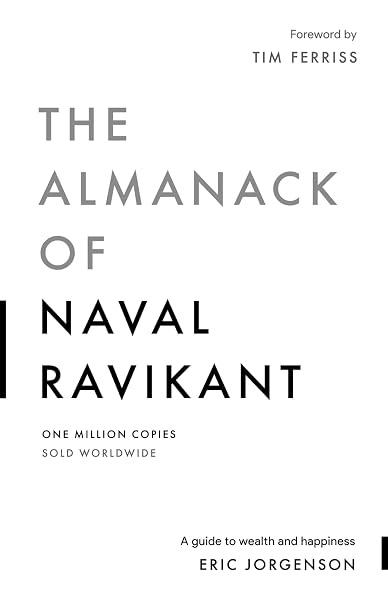
Wealth and happiness explained through one investor's principles: specific knowledge, leverage, and learning to be content with what you already have.
The structure of the book
This is not a book written in one sitting. Jorgenson collected a decade of Naval Ravikant's tweets, podcasts and interviews and organised them into two halves: wealth and happiness. It is a compilation, so it reads as a set of sharp principles rather than an argument developed over chapters.
That structure is the point. You can open it anywhere and find something worth thinking about.
Wealth is not the same as money
Naval's definition is deliberately precise. Wealth is assets that earn while you sleep. Money is how we transfer time and wealth. Status is your rank in a hierarchy.
The distinction matters because pursuit of status looks like pursuit of wealth and produces neither. Status games are zero-sum by definition; wealth creation can be positive-sum.
Specific knowledge and leverage
His formula for getting rich without luck is often quoted: specific knowledge, accountability, and leverage.
Specific knowledge is knowledge you cannot be trained for. It comes from genuine curiosity and feels like play to you while looking like work to others. If society can train someone else to do it, it is not specific.
Accountability means taking business risk under your own name. It is why founders capture disproportionate value: they accepted the downside.
Leverage comes in three forms:
- Labour — people working for you. The oldest form, and the most effort to manage.
- Capital — money that can multiply decisions. Powerful but requires someone to give it to you.
- Products with no marginal cost of replication — code and media. This is the modern form, and it works while you sleep.
The last category is why the book speaks to people with no capital and no employees: a piece of software or a piece of writing can reach millions at almost no extra cost.
Play long-term games with long-term people
One of Naval's most repeated principles. Trust compounds, and it only compounds between people who expect to deal with each other again. Short-term interactions reward extraction; long-term ones reward generosity and reliability.
Happiness as a skill
The second half is where the book becomes unusual. Naval treats happiness not as a circumstance to be achieved but as a default state that gets covered over by desire.
His argument: desire is a contract you make with yourself to be unhappy until you get what you want. Therefore reducing unnecessary desire increases peace more reliably than satisfying it.
Practical implications he draws:
- Choose one big desire at a time. Multiple simultaneous big desires guarantee unhappiness.
- Live in the present. Most suffering is rehearsing the past or pre-living the future.
- Health is the foundation. Exercise, sleep and diet come before any productivity system.
- Judge less. Much of misery comes from an uncontrollable stream of opinions about everything.
Reading and thinking
Naval's advice on learning is refreshingly contrarian. Read what genuinely fascinates you, and put a book down without guilt if it does not. Read the great works in their original form rather than summaries. Develop the habit of thinking alone for long stretches, because original thought requires uninterrupted time.
A fair critique
The book is a compilation, so it repeats itself and lacks a systematic argument. Some advice assumes a level of optionality — savings, health, an in-demand skill — that many readers do not yet have, and "just do what feels like play" is easier advice for the already-secure.
Treat it as a source of high-quality questions rather than a step-by-step plan.
🔑 Key actionable ideas
- Wealth is assets that earn while you sleep; money is just how we move it around.
- Chase wealth creation, not status — status games are zero-sum.
- Build specific knowledge that cannot be trained into someone else.
- Take accountability under your own name to capture the upside.
- Use leverage: code and media scale without permission or marginal cost.
- Play long-term games with long-term people; trust compounds.
- Desire is a contract to be unhappy until you get what you want — choose few desires.
Who is this book for?
Ambitious readers in their twenties and thirties who want a clear framework for building both income and peace, without slogans.
Final verdict
Dense with genuinely useful principles and refreshingly free of hustle-culture noise. Fragmented by design; read it in small pieces rather than cover to cover.