Moonwalking with Einstein
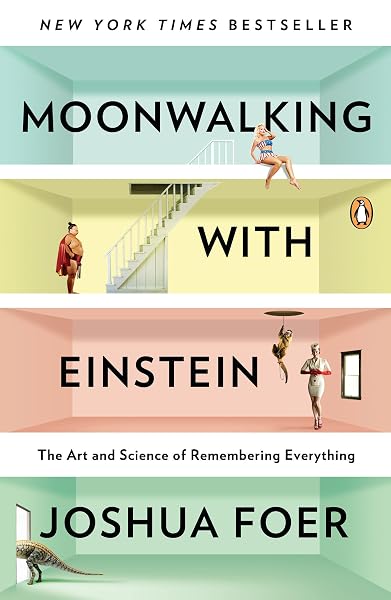
A journalist trains for the US Memory Championship and discovers that the champions are not gifted — they use a technique that anyone can learn and that works alarmingly well.
The experiment
Foer went to cover the US Memory Championship as a journalist, expecting to meet savants. Instead he found ordinary people — a classical musician, a researcher, a man who wrote a book about the search for the smartest person alive — using a technique handed down from ancient Greece.
By the end of the article he had decided to find out whether the technique could work on him. A year later he won the championship.
The memory palace
The core of the method is the memory palace, also called the method of loci. You take a route you know intimately — your childhood home, your commute, a building you have walked a thousand times — and you place the items you need to remember along it as images.
To recall the list, you walk the route and look. The locations are already stored, so you only need to attach one image to each, and the route itself provides the order.
Why it works
The technique exploits two well-documented strengths. First, the brain's spatial memory is exceptional and largely automatic — you can recall thousands of places without effort. Second, memory for images is far stronger than memory for abstractions.
A shopping list of ten words is an abstract, meaningless sequence. Ten absurd images arranged along a familiar hallway becomes a story, and stories stick.
Vividness is load-bearing
Foer's practical advice is that the image must be exaggerated to work. Not a dog, but a dog the size of a bus wearing your grandmother's hat and singing. Not a cup, but a cup that is on fire and also somehow judging you.
The reason is that the brain discards the ordinary. Anything that fits its surroundings is not marked as worth keeping. Grotesque, sexual, moving, or hilarious images are flagged automatically. The technique is deliberately undignified because dignity is forgettable.
The cost of the trick
The honest part of the book is what the technique does not do. Knowing the palace does not make you understand the material, and Foer is clear that memory training and learning are different things.
He also documents his own loss after the championship: without practice, the palaces decay. The technique is a skill that must be maintained, not a permanent upgrade.
What changes besides memory
The most interesting chapter is on a man who memorised large parts of the Bible and, separately, on the effect of having a trained memory on perception. Foer argues that the vocabulary you carry shapes what you notice.
You cannot think about something you have no word for, and you cannot notice a pattern you cannot represent. To that extent the technique changes the person using it, not just their score.
The bottom line
Exceptional memory is mostly technique, and the technique is old, free, and learnable in an afternoon. You will not become a champion without the practice, but you can absolutely stop losing your keys and remember a shopping list on the way out.
🔑 Key actionable ideas
- Memory champions do not have exceptional memories. They have learned a technique, and they are ordinary in every other way.
- The method is the memory palace: place vivid images along a route you know well, and walk it to retrieve them.
- The brain is far better at remembering places and images than lists of words or numbers. Techniques work with that grain instead of against it.
- Vividness is not decoration. A bizarre, exaggerated, moving image is remembered; a sensible one is not.
- Training memory changes what you notice, not just what you recall — the same way learning any vocabulary changes what you can see.
Who is this book for?
Readers curious about how memory actually works, students looking for practical techniques, and anyone who enjoys a good story about an ordinary person going deep into an odd subculture.
Final verdict
A memorable book about memory, which is a neat trick in itself. The science is worn lightly and the memoir framing keeps it moving, though the championship chapters are more compelling than the history ones.