Indistractable
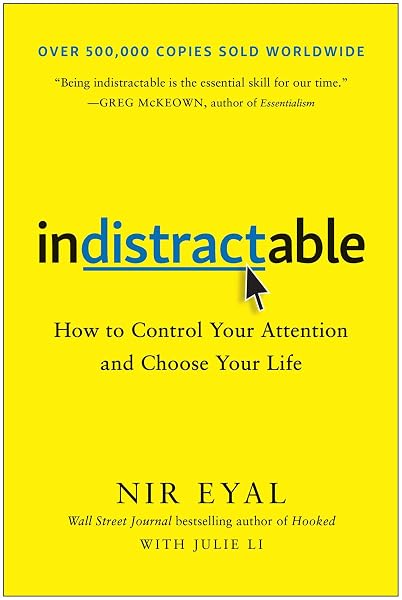
A practical system for attention: manage the internal triggers, timebox your day, and make distraction harder rather than fighting it with willpower.
Start with the trigger
Eyal also wrote a book on building habit-forming products, which makes his diagnosis of distraction unusually credible. He argues we misplace the cause. The app is not the trigger. The trigger is a feeling you are trying to escape.
That is why deleting apps rarely fixes anything. The discomfort remains and finds a new outlet — the fridge, the news, a sudden urge to reorganise a drawer. Treat the trigger first.
Timebox, do not list
A to-do list lets you believe you can do more than a day contains. A calendar does not. Timeboxing means giving every hour a job in advance, including hours for rest and for the people you care about.
The benefit is definitional. With a plan, you can finally say what distraction is. Anything that pulls you off the current box is a distraction, and anything that belongs in a box is not.
Friction and pacts
Willpower is a poor tool because it is weakest exactly when you need it. Eyal prefers changing the environment: log out, leave the phone in another room, remove the app from the home screen.
For the hardest cases he adds pacts — a self-imposed deadline, a commitment with a friend, a price attached to failure. The point is not punishment. It is moving the decision to a moment when you are thinking clearly.
Distraction is not the enemy of work alone
The book insists on the other side too. If you have no time scheduled for rest and for people, those needs will steal time from work anyway, and you will call it distraction when it is really an unplanned priority.
Eyal recommends timeboxing relationships and leisure explicitly, so that attention given to them is chosen rather than stolen, and carries no guilt.
The honest limit
The book does not promise monk-like focus. Eyal is explicit that some distraction is normal, and that the goal is to choose your life rather than drift through it.
The measure he suggests is simple: at the end of the day, did you do what you said you would? Not perfectly. Roughly. That is a far more useful question than how many hours you felt productive.
The bottom line
The most practical book on attention because it treats distraction as a symptom rather than the disease. The system is simple, and the honesty about its limits is what makes it usable.
🔑 Key actionable ideas
- Distraction starts with an uncomfortable internal trigger — boredom, anxiety, uncertainty — that the phone then soothes.
- You cannot call something a distraction unless you know what it distracted you from. Without a plan for your time, everything is equally urgent.
- Timeboxing beats to-do lists because a list has no capacity limit, while a calendar forces you to admit how much time a day holds.
- Make the unwanted behaviour harder and the wanted behaviour easier. Ten seconds of friction is usually enough to break the reflex.
- Pacts with other people — a deadline, a bet, a scheduled commitment — work better than promises to yourself.
Who is this book for?
Knowledge workers, students, and anyone who ends the day unsure where the time went. Also useful for parents trying to model attention for children.
Final verdict
A practical, well-researched system rather than a lecture about willpower. Some of the structure feels padded, but the core insight about internal triggers and the timeboxing method are worth the whole book.