Getting to Yes
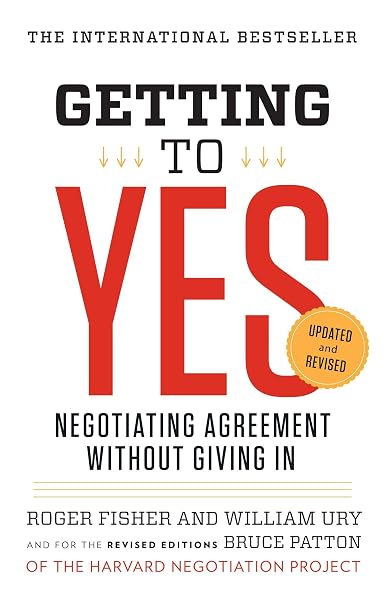
The four-principle method that replaced haggling with problem-solving. Still the clearest framework for any negotiation, from salary to a toddler at bedtime.
Why positional bargaining fails
The default style is positional: each side picks a number, then slowly concedes. It works sometimes, but it costs. It damages the relationship, it rewards stubbornness over insight, and it often produces a worse deal for both sides than was available.
The authors call this a contest of will. The alternative is not to be nicer. It is to change what the conversation is about, from who wins to what problem are we solving.
People and problem
Every negotiation has two threads: the substance and the relationship. Mixing them is what turns a disagreement about a price into a fight about respect.
The advice is to handle the people side explicitly and separately — acknowledge emotions, avoid blaming, listen — and then negotiate the substance on its own terms. Be soft on the person, hard on the problem.
Interests and options
Positions are what people say they want. Interests are why. Behind "I want the window seat" might be a bad back, or a fear of flying, or a need to work on the flight.
Once you know the interests on both sides, you can often find options neither party had considered. The book's exercise is to brainstorm without judging, then evaluate afterwards. Many impasses survive only because no one generated a third option.
Criteria and BATNA
When interests collide, do not push. Reach for an external standard: what does this role pay elsewhere, what did we agree last time, what would a neutral expert say. Independent criteria make concessions feel like fairness rather than defeat.
And know your best alternative to a negotiated agreement. If you have another offer, you can walk. If you cannot walk, you have very little power regardless of how well you argue. Measure the alternative before you sit down.
When the other side is more powerful
The book has a chapter for the case where the other party holds every card. Its advice is to negotiate over what a fair process would look like, and to keep the option of walking away visible even when it is unattractive.
It also recommends negotiating the rules before the substance: who decides, what criteria apply, what happens if you disagree. Setting the framework is often more valuable than winning a point inside it.
The bottom line
A short book that reframes negotiation from a fight into a joint problem. The four principles are simple enough to remember under pressure, which is the only test that matters.
🔑 Key actionable ideas
- Separate the people from the problem: be soft on the person and hard on the issue, instead of the usual reverse.
- Focus on interests, not positions. "I need 60,000" is a position; "I need to stop worrying about rent" is an interest.
- Invent options for mutual gain. Most negotiations look like a fixed pie only because nobody spent five minutes looking for a bigger one.
- Insist on objective criteria — market rates, precedent, expert opinion — so the argument becomes about fairness rather than who pushes harder.
- Know your BATNA. Your power in any negotiation comes almost entirely from how good your alternative is if you walk away.
Who is this book for?
Anyone who negotiates — salary, contracts, house purchases, or a teenager's curfew — and especially people who find confrontation uncomfortable.
Final verdict
The foundational book on negotiation and still the clearest. Later books add psychology and tactics, but this one gives the framework everything else builds on. Short enough to reread before a difficult conversation.