
Flow
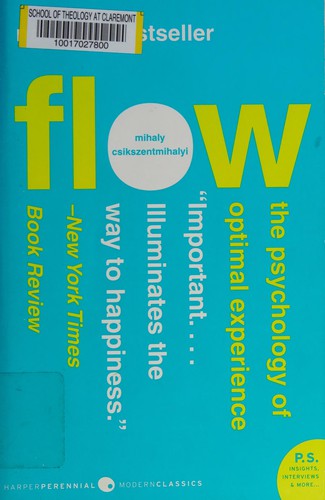
The classic study of optimal experience: how full absorption in challenging work makes life feel worth living, and how to find far more of it in ordinary days.
The Core Idea
Csikszentmihalyi spent decades asking a simple question: when do people feel most alive? The answer, repeated across surgeons, climbers, musicians, dancers and assembly workers, was not rest but full absorption in something demanding. He called that state flow, and this book explains where it comes from and how to find more of it. The central insight is that enjoyment and pleasure are different things: pleasure restores the baseline, while enjoyment actually moves us forward.
A life built only on pleasant distraction tends to feel empty, whereas a life containing genuine challenge tends to feel meaningful even when it is difficult. That comparison, drawn from thousands of interviews and studies in which people recorded their feelings as they went about ordinary days, gives the book its quiet force and keeps it from reading like a collection of inspirational anecdotes. Csikszentmihalyi also draws on philosophy and art, but the empirical backbone keeps the argument grounded.
The Anatomy of Flow
The state has recognisable features: complete concentration with no spare attention left for worry, clear goals, immediate feedback about how you are doing, a sense that your skills match the challenge, and a changed sense of time. These conditions can appear in work, sport, conversation or even routine chores, which is why flow is not reserved for artists and athletes. It is available to almost anyone who arranges the task correctly.
The Challenge–Skill Balance
The most practical idea in the book is a moving window. If a task is far too easy you slide into boredom; too hard and you tip into anxiety. Flow lives in the narrow band where difficulty stretches you just past your current ability. Because your skill grows, the band moves, which is why the same activity eventually needs more challenge to stay absorbing. This single model explains why people leave jobs that once thrilled them and why hobbies quietly go stale. Once you grasp it, you can deliberately adjust difficulty in work, hobbies and even chores to keep them interesting.
Why Work Can Beat Leisure
His research produced a counter-intuitive finding: people often report more flow at work than in free time, yet they say they would rather be doing something else. Work supplies goals, feedback and challenge; unstructured leisure often supplies none of these, so the mind drifts and mood sags. The problem is rarely work itself but the absence of flow in the rest of the day, which can be fixed by turning vague free time into something with rules, goals and feedback.
Attention and the Autotelic Self
The book treats attention as the raw material of experience: what you pay attention to, you gradually become. A life of scattered attention produces a scattered self, while absorbed attention builds order in the mind. Some people seem able to find flow almost anywhere, turning a dull job or a bad situation into a game with its own goals and feedback. Csikszentmihalyi calls this the autotelic disposition and insists it can be cultivated rather than only inherited.
Flow With Others
He extends the idea beyond solitary work. Conversation, family life and community can all produce flow when they offer shared goals and honest feedback, and he suggests that relationships built around shared activity tend to be more satisfying than those built only on passive consumption. Shared challenge, he argues, is a more reliable bond than shared comfort, because it gives people something to do together rather than merely something to feel. He warns, though, that flow is not automatically good: a person can get absorbed in destructive activities, so the direction of the challenge matters as much as its intensity.
A Fair Critique
The book moves between research and reflection, and its later chapters on meaning can feel more philosophical than evidential. Some readers find the prose dated, and self-report methods have obvious limits, so the writing occasionally overreaches into advice the data cannot fully support. Yet the core concept has proved remarkably durable and has quietly reshaped how we think about motivation, games and work design. Few psychology books describe a state you will recognise from your own life this precisely.
🔑 Key actionable ideas
- Flow appears when challenge and skill are closely matched.
- Enjoyment is different from pleasure — one grows you, the other restores you.
- Clear goals and immediate feedback make absorption easier.
- Work often delivers more flow than unstructured leisure.
- Attention is the resource out of which your experience is built.
- You can learn to find flow in almost any activity.
- Absorption can serve good or bad ends — direction matters.
Who is this book for?
Anyone who wants more meaning in work and daily life — managers designing jobs, creatives, athletes and readers tired of passive leisure.
Final verdict
A foundational book whose central idea still holds up. Practical in the middle, philosophical at the end, and worth reading for the challenge–skill window alone.


