
Essentialism
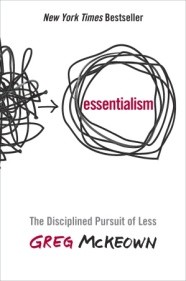
The disciplined pursuit of less: how to identify the vital few things that matter and say a graceful no to almost everything else demanding your attention.
The Core Idea
McKeown's argument is that most of us are spread thin because we believe we can do everything and that doing more is always better. Essentialism replaces that belief with a question: what is the one thing that, if I did it well, would make the rest easier or irrelevant? The aim is not to get more done but to do fewer, better things, and he is explicit that this is not time management. Managing time well lets you take on more; essentialism refuses more so that the vital few get your best hours instead of your leftovers.
The enemy is not laziness but overcommitment. The people who most need this book are usually competent, and competence is exactly what attracts more requests, which is why learning to decline becomes a skill rather than a personality trait. It is a discipline, in his framing, that has to be rehearsed like any other. The book is really about identity as much as scheduling: an essentialist asks what kind of life they are choosing, then arranges the calendar to match.
The Wrong Assumption
The book targets three inherited beliefs: that I must do it all, that it is all equally important, and that I can somehow fit everything in. Each sounds admirable and each guarantees mediocrity, because energy spread across everything produces nothing distinctive. McKeown's alternative is a discipline of deliberate choice: fewer things, done with real attention, consistently outperform many things done adequately, and the gap widens over time. The trade-off is real, and pretending otherwise is how calendars fill up with other people's priorities.
Explore, Eliminate, Execute
The discipline has three phases, and the order matters, because most people jump straight to doing and then wonder why they are busy without being productive:
- Explore — create space to think, then separate the trivial many from the vital few.
- Eliminate — cut the non-essential decisively, including commitments that arrived by default.
- Execute — remove obstacles and build routines so the essential work actually gets finished.
Exploration is really about escaping reactivity. Space to think, careful observation, sleep and genuine play all improve decisions because they restore the perspective needed to tell important from merely urgent. Judgement, in this view, is a skill that needs maintenance rather than a trait you either have or lack. Eliminating is then mostly about courage, because every yes is also a no to something else, often something that mattered more than the request sitting in front of you.
The Graceful No and Sunk Costs
McKeown offers practical ways to decline without damaging relationships: pause before answering, give a clear but kind explanation, and remember that a vague yes today becomes resentment later. He also returns repeatedly to sunk-cost thinking, the tendency to keep investing in something because of what it has already cost, and argues that essentialists judge options by future value rather than by pride or history. That is why they can walk away from a project that no longer deserves its place even after months of work.
Execution as Design
Execution is treated as design rather than willpower. Build in a buffer so that a bad day does not become a disaster, find the smallest viable progress and turn it into a routine, and anticipate the friction that reliably appears so you can remove it in advance. Success, he argues, comes from making the essential path the path of least resistance, so that doing the right thing requires less heroism on the days when you have the least energy to spare. He also emphasises celebrating small wins, because momentum is easier to sustain than it is to restart.
A Fair Critique
The ideas are more inspiring than novel, and readers already familiar with focus literature will find little here that is genuinely new. It also assumes a degree of autonomy over your calendar that many jobs and carers simply do not have, and its confident tone occasionally slides into platitude. Yet as a reminder and as a set of habits, it is useful and well timed, especially for anyone whose real problem is not laziness but overcommitment.
🔑 Key actionable ideas
- Ask what is essential, then have the courage to ignore the rest.
- Every yes is a no to something else.
- Distinguish the vital few from the trivial many.
- Create space to think before you decide what to do.
- Learn to decline kindly but clearly.
- Ignore sunk costs; judge by future value.
- Design routines instead of relying on willpower.
Who is this book for?
Busy professionals, founders and anyone who is competent and therefore over-requested, drowning in commitments that are individually reasonable and collectively impossible.
Final verdict
More motivating than original, but very usable. Best read as a set of habits to install, not as new theory — and worth it for the graceful no alone.


