Burnout
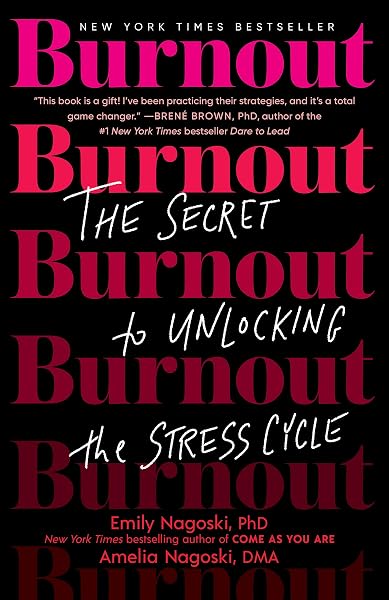
Burnout is not a lack of willpower, it is an unfinished biological cycle. The Nagoski sisters explain what exhaustion actually is and how to complete the stress response instead of suppressing it.
The actual definition
The Nagoski sisters start by dismantling the popular idea that burnout is being tired of your job. Their definition has three parts: emotional exhaustion, depersonalisation — a cynical distance from the people you serve — and a sense that you are no longer effective.
That combination is measurable, recognisable, and importantly not the same as depression or simple tiredness. It is what happens when you have been running a stress response with no off switch.
The stress cycle
The central idea of the book is that stress is a physiological cycle with a beginning, a middle, and an end. A threat appears, the body mobilises, and when the threat passes the body is supposed to return to baseline.
The problem is that the last step needs a signal, and modern threats do not provide one. A deadline does not chase you down the street. So the cycle is left open, running in the background, and the accumulated unfinished cycles are what we call burnout.
Why thinking does not work
This is the part that surprises people. You cannot reason your way out of an unfinished stress cycle, because the response is not in the thinking part of the brain. Telling yourself the deadline is fine does nothing for a body that is still flooded.
The exit is physical. The book lists the well-supported ones: vigorous exercise, slow breathing with a long exhale, positive social interaction, affectionate physical contact, laughter, and crying.
Rest that does not rest
Scrolling, drinking, and numbing are the standard ways people try to recover, and the Nagoski sisters are blunt that they do not complete the cycle. They distract, which is different. You end the evening no less flooded than you started.
The practical advice is to pick one real completion strategy and use it on purpose after a stressful event, rather than waiting for exhaustion to lift on its own. It will not.
The human giver syndrome
A large section addresses what the authors call human giver syndrome — the belief, usually taught to women, that your value lies in what you provide to others and that having needs is a character flaw.
They argue this belief is a direct cause of burnout, because it makes rest feel like failure and makes asking for help impossible. The treatment is not tougher self-discipline but permission, and the book is unusual in naming the cultural cause rather than blaming the individual.
The monitor and the goal
Two chapters deal with self-criticism and meaning. On self-criticism, the finding is that harsh self-talk does not improve performance — it increases the sense of threat and makes the cycle worse.
On meaning, the point is that a life organised entirely around achievement has nothing to fall back on when achievement stalls. Relationships and a sense of purpose outside work are not luxuries on top of a functioning life. They are part of the load-bearing structure.
The bottom line
Burnout is not weakness and it is not solved by trying harder. It is the predictable result of unfinished stress, and it is treated by finishing the cycle in the body, loosening the belief that your needs come last, and rebalancing a life that has been reduced to output.
🔑 Key actionable ideas
- Stress is not the problem. Incomplete stress is. The body has a cycle it needs to finish, and modern life interrupts it.
- You cannot think your way out of a stress cycle. The response lives in the body, and the exit is physical.
- Exercise, deep breathing, affectionate touch, laughter, and crying are the evidence-backed ways to complete the cycle.
- Burnout is not a personal failing — it is what happens when demands exceed resources for long enough, and the fix is structural as much as personal.
- Rest that does not complete the cycle — scrolling, drinking, numbing — leaves the stress exactly where it was.
Who is this book for?
Anyone who has been exhausted for months and cannot explain why, and people in caring or service roles where the pressure is constant rather than episodic.
Final verdict
A useful corrective to the productivity genre, grounded in physiology rather than motivation. The tone is conversational and the cultural argument is strong; readers wanting clinical depth will need to look elsewhere.